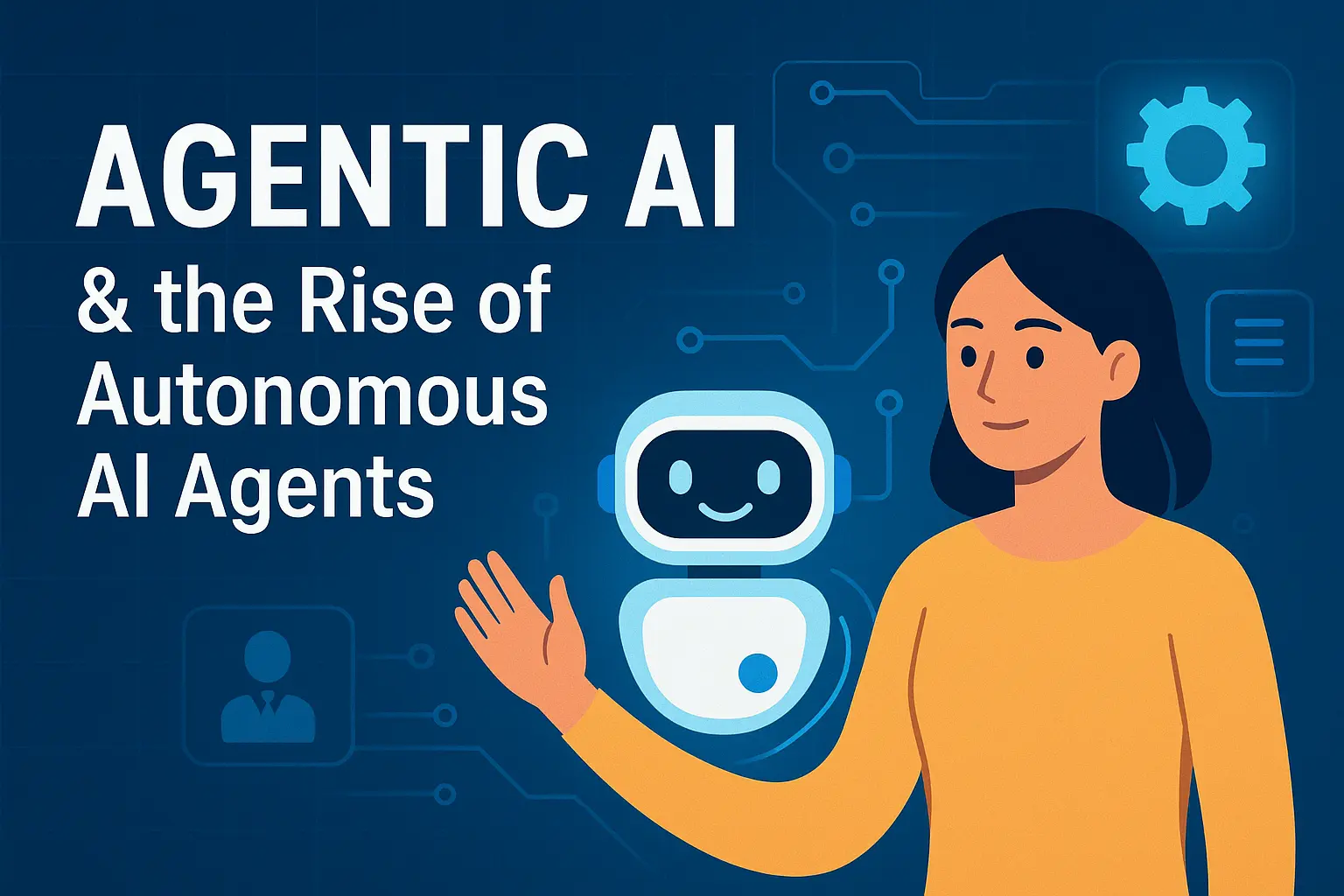
In the infancy of artificial intelligence, most systems were reactive tools: you ask, they answer. But 2025 may mark a turning point, AI no longer just responds, but acts — with agency. These new “AI agents” can initiate tasks, make decisions, and operate semi-independently. This shift brings exciting possibilities and serious challenges.
What Are Agentic AI / Autonomous AI Agents?
Definition: AI systems that don’t just wait for prompts but take initiative — plan, execute workflows, fetch and process data, trigger follow-ups.
Contrast with traditional AI: Traditional models (chatbots, classification models) require direction; agents can interpret intent and act.
Current examples / early stage tools
“Copilot”-style assistants embedded in software suites
Task orchestration agents in enterprises
Research prototypes combining planning + execution
Drivers Behind Their Rise
Compute & Model Advances
More powerful base models + fine-tuning
Efficient architectures, modular agents
Integration & APIs Everywhere
Agents can connect with many services: calendars, emails, CRMs, IoT
Demand for Automation
Businesses want less manual handoffs, more proactive systems
Efficiency, scalability, cost-cutting
Foundational Research & Investment
Big investments into agent frameworks, safety, autonomy
Use Cases & Potential Benefits
Professional productivity: Agents that manage your schedule, draft emails, monitor projects
Business process automation: Automating repetitive workflows end-to-end
Customer support & interaction: Dynamic agents managing customers, resolving issues
Smart homes / IoT: Agents coordinating devices, energy use, home tasks
Challenges, Risks & Ethical Considerations
Safety & Error Mitigation
What if an agent makes a bad decision?
Fail-safes, human oversight
Accountability & Governance
Who is liable for agent actions?
Legal frameworks, auditability
Bias & Fairness
Agents operating across domains may unknowingly propagate bias
Privacy & Security
Sensitive data access, malicious exploitation
Trust & Explainability
Users need to trust agents; black-box actions are concerning
Governance & Regulation Needs
Global standards (interoperability, safety)
Certification / auditing for agents
Transparency mandates: logging, explainability
Regulation of high-risk domains (finance, health, critical systems)
What This Means for Businesses & Users
Organizations that adopt agents early can gain productivity advantage
Need internal AI governance teams
Users must adapt: from commanding AI to supervising it
New roles: “Agent manager,” safety auditor
Future Outlook
Agents will become more general-purpose, context-aware
Hybrid human-AI collaboration models
Convergence with robotics and edge computing
Rising importance of AI agent ecosystems
Conclusion
Agentic AI is not a science fiction dream — it is now emerging. The shift from passive tools to autonomous agents could reshape how we work, live, and interact with machines. But the transition must be managed carefully, with ethical guardrails, regulation, and human oversight. As we step into 2025, agents might well become our digital copilots — not in structure, but in intent.